
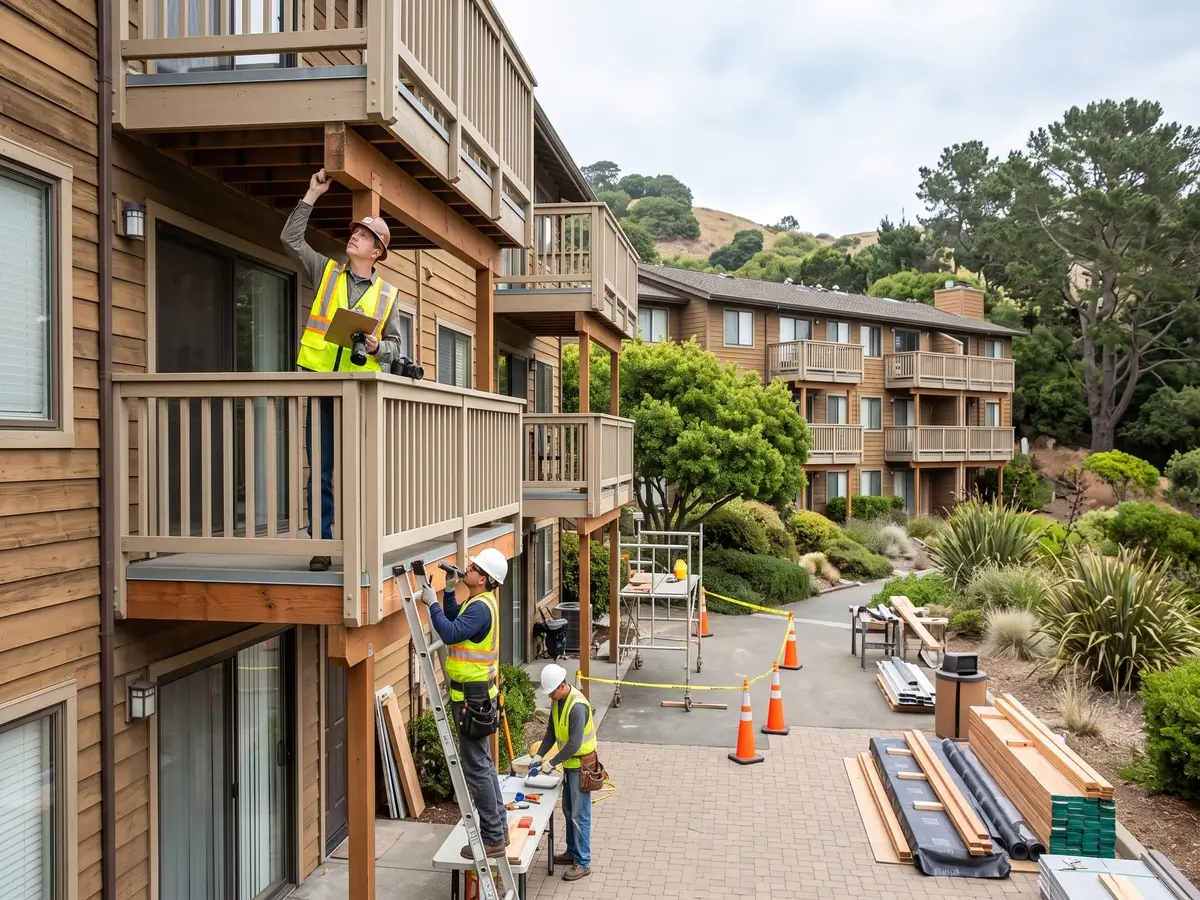
Is the Balcony Above Your Marin Courtyard Still an Open Compliance File?
The inspector came, walked the balconies, and left. Weeks later, a report landed in your inbox, and you filed it away with a sigh of relief. Deadline met. Done.
Except the report was never the finish line. Somewhere in those pages may be a repair finding with a 120-day permit clock already running, and daily penalties waiting if the work stalls. And some owners never booked the inspection at all.
Here is what SB 721 expects from apartment owners now that January 1, 2026 has passed, and how to keep your building safe, insurable, and sellable.
Key Takeaways
Here is what every Marin apartment owner should know about SB 721 right now.
The deadline has passed, but the duty remains: Buildings with three or more units still need a completed inspection, and acting late is better than not acting at all.
Repairs run on a clock: Non-emergency findings require a permit application within 120 days of the report, and the work must be finished within 120 days of permit approval.
Penalties follow unfinished work: Repairs left undone past the statutory window can bring local civil penalties of $100 to $500 per day and a recorded building safety lien.
Records are part of compliance: Reports must be kept for at least two inspection cycles and delivered to the buyer when the building sells.
SB 721 Essentials in Five Figures
43+ years: PRANDI Property Management's experience serving Marin County rental owners |
3+ units: Building size that triggers SB 721 inspection requirements |
15%: Minimum sample of each type of exterior elevated element that must be inspected |
120 days: Window to apply for a repair permit after receiving a non-emergency report |
$100 to $500: Daily civil penalty range once uncompleted repairs pass the statutory window |
IN THIS GUIDE
Which Marin Buildings SB 721 Actually Covers
Your Next Move Depends on Where You Stand Today
Tenants, Access, and Communication During Repairs
Records That Protect Your Building's Value
Mark Your Calendar for January 1, 2032
Which Marin Buildings SB 721 Actually Covers
SB 721 is narrower than many owners assume, yet it reaches a large share of Marin's apartment stock.
Buildings With Three or More Units
The law, codified in California Health and Safety Code Section 17973, applies to buildings with three or more multifamily dwelling units.
Condominiums are governed by a separate law, SB 326. For owners of San Rafael fourplexes or Novato garden-style complexes, SB 721 is the applicable rule.
Elevated, Wood-Supported Structures
The law targets exterior elevated elements, meaning balconies, decks, porches, stairways, walkways, and entry structures that extend beyond the exterior walls.
To qualify, the walking surface must be more than six feet above ground and rely, in whole or in substantial part, on wood for structural support. The inspection also covers the flashings, membranes, coatings, and sealants that keep water away from those load-bearing parts.
In a county known for wet winters and coastal fog, hidden moisture damage is exactly what this law was written to catch.
Your Next Move Depends on Where You Stand Today
Post-deadline obligations vary depending on what your inspection did or did not uncover.
If Your Building Has Not Been Inspected Yet
Book a qualified inspector now. The law limits who can sign off: a licensed architect, a licensed civil or structural engineer, an "A," "B," or "C-5" contractor with at least five years of multistory wood-frame experience, or a certified building inspector who is not employed by the local jurisdiction.
At least 15 percent of each type of elevated element must be inspected. The signed report, with photographs and a projected service life, is due to you within 45 days.
If asbestos is confirmed, owners have up to 9 months for abatement, then 3 months to finish.
If Your Report Flagged Non-Emergency Repairs
You have 120 days from receiving the report to apply for a permit, then 120 days after approval to complete the work. A licensed contractor must perform the work according to the inspector's recommendations and current building code, and you can confirm any license through the Contractors State License Board.
If repairs are not complete within 180 days, the inspector notifies the local enforcement agency. Thirty days after that notice, civil penalties of $100 to $500 per day can begin, and the city or county may record a building safety lien carrying the force of a judgment lien.
If the Inspector Found an Immediate Threat
Emergency findings move fast. The inspector must send the report to both the owner and the local enforcement agency within 15 days, and owners must take preventive action immediately.
Blocking occupant access to the unsafe element until repairs are done counts as compliance, but the repairs still need permits, reinspection, and a report to the agency.
In every scenario, speed and documentation keep a manageable repair from becoming an enforcement file.
A balcony report is a repair schedule with a legal deadline attached, and it deserves to be managed like one.
Tenants, Access, and Communication During Repairs
Inspections and repairs happen where residents live, so the human side needs real planning.
Giving Proper Notice Before Entry
California Civil Code Section 1954 generally requires reasonable written notice, typically 24 hours, before entering a unit for inspections or repairs.
Keeping Residents Informed Through Closures
Closing a deck or stairway affects daily life and can raise questions about use of the unit. Clear explanations, realistic timelines, and written records of every closure protect resident relationships and your position if a dispute arises.
Coordinated maintenance services that handle vendor scheduling, entry notices, and tenant updates turn a disruptive project into a predictable one.
Records That Protect Your Building's Value
SB 721 writes record-keeping directly into the owner's obligations.
Retention: Keep every inspection report for at least two inspection cycles, which means roughly 12 years.
Continuity: Each future report must incorporate prior reports, including the locations of elements inspected.
Sale disclosure: Reports must be disclosed and delivered to the buyer at any subsequent sale of the building.
Proof of repair: Ask the inspector for a final report confirming the work is complete, as the law allows owners to request one.
Cost records: Store repair invoices and permits alongside each report, which also simplifies rental tax season.
Local agencies may require copies, and cities and counties can adopt stricter rules than the state. Confirm requirements with your city's building division or Marin County for unincorporated areas.
This kind of local tracking sits at the heart of a compliance-first approach to managing Marin rentals.
Mark Your Calendar for January 1, 2032
The first round was only the beginning, because SB 721 runs on a six-year cycle.
When Your Next Inspection Is Due
The next inspection deadline for most covered buildings is January 1, 2032. Buildings with permit applications submitted on or after January 1, 2019, follow their own schedule, with inspections due within six years of the certificate of occupancy.
Maintaining Elements Between Cycles
Between inspections, ongoing maintenance remains the owner's responsibility. Treat coatings, flashing, railings, and drainage as routine items.
Track reserves for the next cycle using detailed owner statements, and schedule periodic visual checks so that 2032 brings confirmation rather than surprises.
FAQs about SB 721 Balcony Inspections in Marin County
Does SB 721 apply to my Marin County duplex?
No, the law applies to buildings with three or more multifamily dwelling units. Duplex owners should still maintain elevated decks and stairs, since liability remains.
I rented a condo. Is the balcony my responsibility under SB 721?
Condominiums are excluded from SB 721 and fall under SB 326 instead. Your HOA typically coordinates those inspections, so review your association's records.
Can my regular handyman perform the inspection?
Not unless they hold one of the qualifying licenses or certifications listed by law. An unqualified inspector can leave your building out of compliance despite the expense.
What happens if I sell before repairs are finished?
Inspection reports must be delivered to the buyer, so unresolved findings become part of the negotiation. Finishing repairs and securing a final report before listing strengthens your position.
The Deadline Passed. Your Building's Safety Clock Is Still Running.
Compliance in 2026 is measured by repairs finished and the records kept, long after the inspector leaves.
SB 721 did not end on January 1, 2026. Marin apartment owners still face repair windows, daily penalties for unfinished work, strict record retention, and a 2032 reinspection cycle that will arrive sooner than it seems. The owners who come out ahead treat their balcony report as an active project with dates, budgets, and follow-through.
At PRANDI Property Management, we have spent over 43 years protecting Marin County rentals. Our multi-family property management team coordinates qualified inspectors, licensed contractors, tenant entry notices, and the documentation trail that keeps your building safe and sellable.
From the first site walk to final sign-off, we keep every deadline visible so nothing slips between inspections. Call us at 415.482.9988 or reach our San Rafael office to turn your SB 721 obligations into a clear, on-schedule plan.